Your Vote Is Not a Special Snowflake, Except When It Is

Nader sure was right that there was no difference between Gore and Bush. Did you vote for Bore LOL or Gush LOL? LOL! By No machine-readable author provided. Bachrach44 assumed (based on copyright claims). [Public domain], via Wikimedia Commons
I wanted to save writing a post about protest voting and single-issue voting until closer to the general election. In case I have any tiny influence with the people reading this blog, it would be better to read this argument in the immediate run-up to the general election rather than a year out when nary a primary vote has been cast. But sometimes you read something so stupid that you want to rebut it as quickly as possible, before it has a chance to become unchallenged received wisdom.

The argument is not so relevant to primary contest voting, though in rare circumstances it can be. The argument is better suited to the general election, when the country is going to have two choices, Republican or Democrat, and any third choice will have the power to spoil the election for one of the two major parties but will certainly not get near the presidency himself or herself. The argument is simple: figure out which major party you prefer and vote for its candidates; otherwise, you have wasted your vote, or worse, you have flipped the election to the party you least prefer.

This argument comes from shame and love; shame for my vote for Ralph Nader in 2000, and love for the country that unfortunately has a political system in which only two major parties can exist.

The piece prompting this post – “10 Reasons I’m Only Voting for Bernie Sanders and Will Not Support Hillary Clinton” – popped up in my Google News feed this morning. The author, H.A. Goodman, is a bit cheeky in that he never comes right out and says he won’t vote for Clinton under any circumstances, but that seems to be what he’s getting at, especially since he writes that he “will not vote for Hillary Clinton or Trump,” like those two are similarly bad choices. If Goodman had stopped at making a case for Sanders over Clinton in the primaries, fine, no harm done. By conflating Clinton and Trump, however, he buys into one of the myths about American politics that cause people to be ill-informed and to vote against their own interests.

Goodman is guilty of promoting two myths in his piece. First, the idea that there is no difference between Hillary Clinton or a Republican in the general election contest for president is so asinine, it makes you wonder if the author is just trolling. The second myth he buys into, that a significant proportion of American voters are “independent,” calls into question whether or not Goodman is at all familiar with the actual voting tendencies of the American public. As political science has shown again and again, “independent” voters are in fact overwhelmingly attached to one party or the other. They just get off on calling themselves “independent.”

In spite of these huge errors in analysis, Goodman makes several good points in his piece about how some of the general survey data about Clinton, like how many people like her or find her trustworthy, are alarming. He also makes a believable case for why Sanders can win the general election. Too many Clinton supporters are dismissing Sanders because they believe he can’t win the general election. It is not clear at all that Sanders would disappoint Democrats in a general election.

Whether Goodman is trolling or not, the danger of his piece is that it conflates the two major political parties and threatens to depress primary voters whose preferred candidate does not win the nomination. If you think Clinton is no better than Trump or any other Republican, why would you bother to go out and vote if she’s the nominee? If you’re a Clinton supporter, why would you work to elect Sanders if he’s the nominee after his supporters spent eight months trashing your candidate as no better than a Republican? Of course, voters who prefer the Democratic Party ought to put aside their differences and rally around whoever is the general election candidate, which painfully reminds me of the 2000 election.

In 2000, I was living, attending school, working, and paying taxes in Virginia, so I changed my voter registration to that state. At the time, Virginia was a solidly Republican state, so I as a naïve 20-year-old talked myself into voting for Ralph Nader as a protest vote. After all, Nader and his supporters had told me there was no difference between the Republican and Democratic parties! And since Bush was going to win Virginia anyway, why not register my disgust with the system? That’ll show them!

Democracy is a funny thing. Voting in a large country like the US is a dumb, statistically insignificant thing to do until it’s not. Famously, Al Gore lost the 2000 election thanks to falling 537 votes shy in Florida, while Nader received 97,488 votes there. Members of the Florida Nader coalition had a statistically more significant opportunity to affect the outcome of that election, and had 538 of them switched their vote from Nader to Gore, well, tell me again how there was no difference between Gore and Bush. While my protest vote ultimately didn’t matter in Virginia, I regret it to this day.

Single-issue voting is similarly counterproductive to a preferred electoral outcome when it comes to the general election. Single-issue voting has its place in primary contests, where a party’s base of support has its opportunity to hash out the direction of the party.

In a general election, any given candidate’s basket of positions needs to be evaluated in aggregate. Of course, a voter may give added weight to certain issues, which helps explain why I liked Barack Obama better than Clinton in the 2008 primaries because of foreign policy, while I would have preferred Clinton to any Republican in the general election had she won the nomination. America’s two major parties now stand for completely different agendas, and it’s a voter’s duty to figure out which one he or she shares. The Democratic primaries appear to be getting ugly, and ultimately, Sanders and Clinton partisans need to remember that it’s the party, much less than the person, that they are voting to empower.

Further reading on related topics: on the moral purposes of voting in a democracy, and how change within the American system really happens (spoiler: it’s not protest or single-issue voting).

Weekend Links

mmexport1447135799616
Actual tortillas made by the author’s actual wife.
mmexport1447135799992
Yum.

We invited one of the students in my adult class and her husband over for dinner tonight. This student, who goes by the English name Dana, is really impressive in her dedication to learning English. She teaches full time at a local high school. This year, Dana is the lead teacher for a class of high school seniors who are preparing for university. Since during this academic year the students focus relentlessly on the gaokao, China’s high-stakes university entrance exam, Dana often has to report to school on Saturdays and Sundays in order to help and coach her students as they prepare for the grueling exam. Faced with six and seven day work weeks, she still somehow makes the time to come to my class that meets from 7 to 9 pm on Mondays and Fridays. She always does her homework, and manages to study and practice her English nearly every day. Students like Dana really make teaching rewarding.

We ended up making a southwestern style pulled chicken in our slow cooker, served with flour tortillas, tortilla chips made from some of those tortillas, salsa, and a side salad. Our guests seemed to like the meal, though they probably wouldn’t have told me the chicken was a little overcooked even if they thought it (it was).

Anyway, this is a good excuse to link to the tortilla recipe we use. My wife made them this time, and they turned out very well as usual. This recipe is adapted from some other person’s recipe, which is a topic I wrote about here recently.

Some links for the weekend:

  • Charlie Pierce on Obama’s rejection of the Keystone XL pipeline. For an asinine take, go read the Washington Post editorial board’s piece. This opinion manages to hit all of the both-sides-do-it sweet spots while somehow managing to miss the real story: people of different political persuasions working together to kill a dumb, short-sighted project. The Post is too caught up in its Democrats-are-just-as-much-to-blame-as-are-Republicans narrative to see that the fight over this pipeline was not only about climate change, but also about midwestern farmers who didn’t want their lands seized under eminent domain or their water supply poisoned. Five minutes searching online and I’m better informed than the Washington Post editorial board.
  • I wrote about Ben Carson this week. Josh Marshall walks us through the latest developments in the Ben Carson-is-a-lying-liar saga with a series of posts here, here, and here. Marshall also links to a (subscription required) hit piece in the Wall Street Journal. The appearance of this article means that Carson’s rise to the top of the polls is inviting backlash from his opponents and the Republican establishment. It will be interesting to see if his poll numbers suffer. So far, similar oppo research pieces have not seemed to hurt Carson’s chief competitor for frontrunner status, Donald Trump.
  • My wife pointed me to her friend Daniel Denvir’s piece in Salon about Hillary Clinton’s past support for welfare reform. I guess this piece has generated a bit of backlash. Denvir argues that Clinton’s camp is accusing Bernie Sanders’ camp of sexism in order to deflect criticism of her own (bad) record. He raises good points about Clinton’s record and where she stands now, but he doesn’t do himself any favors by dismissing accusations of sexism out of hand, or by labelling Clinton’s past policy preferences “sexist” and “racist.” I honestly don’t know what to say here, since it’s true that Clinton’s past record is problematic, and it’s also true that Clinton is often the victim of sexist remarks. Both Clinton and Sanders, or Martin O’Malley for that matter, are infinitely preferable to any Republican on almost every issue. I’d prefer to see their campaigns and their surrogates refrain from mudslinging. But politics ain’t beanbag.

Enjoy the weekend!

The Republican Nomination Contest: Ben Carson, Really? Really? Edition

Really? Gage Skidmore [CC BY-SA 3.0 (http://creativecommons.org/licenses/by-sa/3.0)%5D, via Wikimedia Commons
Famed pediatric neurosurgeon and crackpot pyramids theory enthusiast Ben Carson is now challenging Donald Trump for frontrunner status in the race for the Republican nomination for president. As mentioned previously, this new development could really complicate Trump’s core message, which seems to be that he’s a winner and winner’s win so vote for him if you want to win and be a winner. It might be difficult for Trump to overcome any stench of loserdom.

Two months ago, Trump had double Carson’s support. Actually, Trump’s numbers are only down slightly from then. So Carson is gaining support but so far not at Trump’s expense.

Ed Kilgore, in his weekly column at Talking Points Memoexplains why Carson could have more staying power than previous candidates who seemed to be running for president in order to promote their personal brands. Carson is spending his impressive amount of funds in exactly the ways you’d expect a grifter to spend them. The differences between Carson and his 2012 versions, Herman Cain and Newt Gingrich, are that Carson may have a broader base of support and he does not reek of failure and personal scandal (though as Kilgore notes, Carson’s connection to a shady nutritional supplements firm could snowball if it’s truly bad or not handled well).

It’s not clear if Carson’s surge is a significant development or not. What’s clear, though, is that the Republican establishment’s preferred candidates are still stuck in the mud. If anything, they are in worse position than they were two months ago.

(So we’re clear on our terms, the ‘Republican establishment’ refers to the Republican National Committee, Republican officials who mostly care about winning elections in order to keep taxes low and regulations limited, and their donors. Any candidate likely to get killed in a general election, like Trump, Carson, or Ted Cruz, make the main goals of low taxes and limited regulations less achievable, and are therefore anametha to establishment figures.)

FiveThirtyEight‘s Nate Silver tries to understand what’s going on and finds that the Republican Party might really be in disarray, making previously thought impossible outcomes, like the nomination of a Trump or a Carson, possible. Among Silver’s many interesting insights is this one: Republicans in Congress, one of the three main pillars of the GOP establishment, have been extremely, and historically, hesitant and slow in bestowing endorsements on the candidates for president this cycle. If the Party establishment is not deciding, as it did with George Bush in 2000, John McCain in 2008, and Mitt Romney in 2012, then the ‘Invisible Primary’ theory of how a party’s establishment chooses the candidate may not adequately explain the Republican contest.

Knowing all the usual caveats about polling this far out from the actual contests, a look at the polling averages compiled by RealClear Politics shows just how dire the situation is at the moment for establishment candidates:

  • Non-establishment candidates (Carson, Trump, Cruz, and Mike Huckabee) combine for 60.8% support nationally, 62.9% in Iowa, 48.5% in New Hampshire (Carson, Cruz, and Huckabee’s religion on their sleeves schticks don’t play as well in New England) and 62.3% in South Carolina (the third state to hold nominating contests).
  • Establishment “frontrunner” Marco Rubio has enjoyed a 2% “surge” in the wake of the last Republican debate, but that still puts him at only 11% nationally (good for third place), 12% in Iowa (fourth place), 10.3% in New Hampshire (third place), and 8.3% in South Carolina (third place).
  • Nationally, establishment candidates (Rubio, Jeb Bush, John Kasich, Carly Fiorina, and Chris Christie) register a robust 25.6% combined.

When your current hope, Rubio, is a guy that 89 out of 100 Republican voters don’t want to vote for, you’re in trouble. This can still turn around, but analysts are starting to sound like broken records: yes, they say, the Republican base is flirting with crazy, unelectable candidates, but they always do that, and they’ll come around and hold their nose and pull the lever for Rubio or Bush by March 2016. Silver’s point is that something could really be different this time around.

Another interesting consideration here is a dirty secret of Republican presidential politics: liberal states that send zero or few Republicans to Congress or rarely vote for Republicans for president anymore hold a lot of power in the nominating contest. Many Republican voters in these states, still attached to the party and pining for the long gone days of the moderate northeastern Republican, want to make sure the Republican nominee is a person that can win the general election. This voter wants a nominee that he or she knows will never win in Massachusetts, but might be able to win one of the swing states, like Florida, that the Republican party needs in order to win the general election. Establishment types are hoping that liberal states will perform their role as firewall against the candidacies of Carson, Trump, and Cruz. We’ll see.

Frankly, I hope they nominate Carson (or Trump or Cruz, for that matter). The country needs to see clearly the beast that the Republican Party has become. What better way than to nominate a crazy guy who is crazy.

Morning Coffee in China Links

IMG_20151103_095148

First blue sky and sun we’ve seen in three days here in Dali. We got our first taste of the cold season here these last few days, and it tasted bitter! While Dali’s winter climate is quite mild, it’s kind of a tough season because there are no central heating systems. We use (terribly inefficient) space heaters and electric blankets and layer up the clothing, but still, for three to four months of a year here you rarely feel warm. It’s usually clear in the winter, so going outside for sun breaks is key to health and well-being. Often, it’s much warmer outside in the sun than inside a building.

Some links from my morning internetting:

  • Talking Points Memo finds a poll with Ben Carson reaching 50% support as first or second choice among Republican primary voters.
  • TPM’s founder Josh Marshall wonders where the outrage is from media platforms and personalities that would be killing Democrats if they decided to boycott Fox News. Republicans are now boycotting NBC because of last week’s CNBC debate, which was awful, but not for the reasons Republicans think.
  • Via his post at Lawyers, Guns and Moneyhere’s Robert Farley’s piece on China’s new submarine capabilities.
  • LGM’s Erik Loomis writes about the mixed blessings of the return of some manufacturing jobs to the US. China is losing its competitive edge in some manufacturing sectors, in part because much of the US has decided through its policies to treat its workers like China treats its workers: bad hours, low wages, and few benefits.
  • Some (kind of) good news for once. Charlie Pierce’s old friend – the Keystone XL pipeline he refers to as “the continent spanning death funnel” – is going to hibernate and hopes to wake up to a Republican president in a year’s time.

Cheers!

Reality Has a Well-Known Liberal Bias, Paul Krugman Edition

Rob Corrdry once told Jon Stewart that “the facts themselves are biased.” By Gage Skidmore from Peoria, AZ, United States of America (Rob Corddry Uploaded by maybeMaybeMaybe) [CC BY-SA 2.0 (http://creativecommons.org/licenses/by-sa/2.0)%5D, via Wikimedia Commons
“Reality has a well-known liberal bias.”  Stephen Colbert’s more famous version of the idea spoken at the 2006 White House Correspondents Dinner. By David Shankbone from USA (Stephen Colbert Uploaded by maybeMaybeMaybe) [CC BY 2.0 (http://creativecommons.org/licenses/by/2.0)%5D, via Wikimedia Commons
Why don’t facts say what we want them to say? Paul Krugman has been on this beat for a long time, notably writing in 2014 about conservatives unable to deal with the fact that the Affordable Care Act, aka Obamacare, was doing what it was designed to do.

Here, Krugman catches The Federal Reserve Bank of St. Louis compiling pesky facts that show private sector employment during Obama’s presidency has not been the nightmare of Republican fever dreams. In fact, the rate of private sector job growth since the recession hit bottom has been much better than anything we saw under George W. Bush.

Another inconvenient fact Krugman’s been tracking over the years is that inflation has remained extremely low in spite of constant warnings from the Right that hyperinflation is just about to break out or is already happening (to argue that it’s already happening, some have claimed that Obama’s minions at the Bureau of Labor Statistics manipulate its CPI measurement). I mean, we’ve all seen recent spikes in the prices of our Rembrandts and van Goghs, right? Clearly inflation is here!

Krugman reminds us that one proponent of inflation-is-here-to-eat-your-children nonsense is Marco Rubio’s new benefactor Paul Singer. Seriously, Singer believes his anecdotal evidence that real estate prices are up in Manhattan and London and that high-end art is more expensive these days means that the Consumer Price Index (CPI) must be understated. Yes, that’s right, clearly the CPI that measures the things we mere peasants consume, like food and gas, must be wrong because Paul Singer once saw an expensive apartment for sale in the Upper West Side.

(General explanation of the concept of liberal bias here. Corddry quote found here and Colbert quote here.)

Weekend Links

IMG_20151031_181254
Halloween selfie!

Hope everyone had a great Halloween. We arranged a trick-or-treating experience for the kids in our school with the help of 20+ friendly businesses here in Dali, Yunnan Province in China. It was a lot of fun. As my wife noted, it was interesting to see how quickly Chinese kids – who had never been trick-or-treating before – picked up the familiar rhythms of Halloween: say “trick or treat,” get candy, say thank you, walk as quickly as possible to the next place for more candy, repeat. Our horde of 60+ costumed kids (and even some of our adult students joined in costume) moving through town was quite the spectacle. It looked like we made a lot of people’s nights, and had a great time ourselves.

mmexport1446354195439
Here I am with one of my classes. I’m supposed to be a pirate.

Some links for the weekend:

  • Here’s a more respectful piece on John Boehner’s tenure as congressman and Speaker of the House than the one I wrote just after he announced his decision to leave.
  • Among Charlie Pierce’s many good reads this week is this one on the “Palinization” of the Republican candidates. Apparently any question that asks a Republican candidate to explain himself or herself, or his or her policies, is evidence of liberal bias. I look forward to debates run by candidate-approved moderators, such as Sean Hannity, that include hard-hitting questions like “Why does Hillary Clinton love terrorists so much?” and “Assuming Zombie Reagan doesn’t enter the race and we can’t vote for him, please tell us how much you love Reagan, and why are you the next best choice?”
  • Martin Longman on the problem “sane” Republican candidates are having calling out the insane ones. The word “sane” in quotes gives it away, but that problem would be the fact that they are just as full of it as the insane ones.
  • David Brooks, a writer I dislike, annoys Paul Krugman so much this time that Krugman calls his New York Times colleague out by name. Scott Lemieux at Lawyers, Guns, and Money reminds us that Brooks-style commentary on the more nebulous aspects of candidates, such as their “signals” or tone, is one of the reasons we ended up with eight years of George W. Bush.
  • Scott Lemieux on the death of ESPN’s sports and pop culture website Grantland. Nothing to add really; as Lemieux notes, hopefully its writers will find work somewhere, because they are some of the best.
  • Two months have passed since I wrote this about the Republican primaries and quite a bit has changed, though the basic dilemma facing the Republican establishment has not. I’d like to update my analysis of the polls next week, but in the meantime here are some quick takeaways:
    • Scott Walker, one of the candidates I listed as an establishment favorite, is toast.
    • Establishment candidates are doing even worse taken together than they were two months ago.
    • Support for Ben Carson has surged and it’s now less likely that he will drop out before the primaries begin.
    • Carson challenging Trump for king-of-the-polls status really complicates Trump’s core message that he’s a winner so vote for him because winners win and voters who vote for winners win, or something.

Enjoy the rest of the weekend!

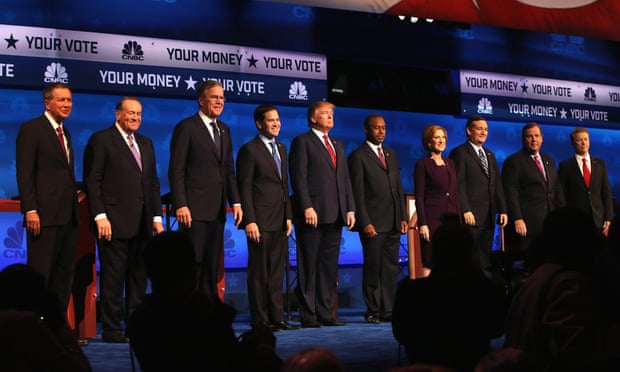
The Agony of Debate: CNBC, Candidates All Manage to Offend

Who won? Who lost? Nobody won and America lost. Photograph: Justin Sullivan/Getty Images

Tonight’s Republican debate was terrible. After listening to several sneering exchanges about how government is always the problem and always screws things up and Obama welcomes violence against the nation’s police and BOO! socialism, I couldn’t get this refrain out of my head: Nasty people saying nasty things and being nasty to each other to the cheers of other nasty people. And before anyone says I should leave the audience out of it, these are the same kind of people who booed a gay soldier for asking a question during a 2011 Republican debate. That’s who these people are, and anyone who supports Republican candidates needs to own it.

The debate was bad for several reasons. First, as Josh Marshall explains, CNBC lives in its own weird universe and the moderators asked several suitably weird questions. One even managed to make me feel bad for Trump by asking if he’s running a “comic book version” of a campaign. Trump’s campaign definitely straddled the joke-or-not line in its infancy, but for better or worse (worse, obviously), his campaign is no joke now.

Marshall also notes that Ben Carson, now leading in Iowa, does not focus or dominate a debate the way a frontrunning Donald Trump can focus and dominate.

But mostly the debate was bad for the ten reasons on the stage: Kasich, Huckabee, Bush, Rubio, Trump, Carson, Fiorina, Cruz, Christie, and Paul. Whether it was the liar Fiorina telling lies again, Carson lying about his involvement with a shady nutritional supplements firm, Huckabee trafficking in ugly (debunked, of course) Clinton conspiracies, or Christie free associating his way to an ugly smear of President Obama, the refrain just kept coming back to me: Nasty people saying nasty things and being nasty to each other to the cheers of other nasty people.

If anything of consequence came out of this debate, I think Charlie Pierce may be right that Jeb Bush’s campaign is now dead. Bush’s campaign will shuffle along, indefinitely and zombie-like, but when your candidate is whining on the campaign trail and can’t manage to land a punch against the insufferably dumb and stupid Marco Rubio, it may be time to follow Scott Walker’s lead and find a different way, other than running for president, to make the world a worse place.

My final takeaway is that Bush and the CNBC moderators managed to lay out partial blueprints for how to attack Rubio, so it will be interesting to see who picks them up and comes after Rubio soonest and hardest.

Polls next week ought to account fully for any effects from the debate. I don’t think any of the ten candidates (not sure about the four jokers at the kiddie table debate) will feel compelled to drop out as a result of this one. If I had to bet, I’d say Rand Paul will drop out next because he’s had trouble galvanizing his father’s base of support and people are worried he’s taking his 2016 Senate re-election bid for granted. But never underestimate these people’s vanity.

Boehner Saves the Day, Sort Of

A Freedom Caucus member reacts to the news. By steenslag (P1010533) [CC BY-SA 2.0 (http://creativecommons.org/licenses/by-sa/2.0)%5D, via Wikimedia Commons
We won’t have John Boehner to kick around much longer and it looks like he’ll succeed in doing the country a favor by kicking his party’s own Freedom Caucus in the teeth before he steps down as Speaker. I still hesitate to give much credit in a situation that involves Republican party leaders saving the country from their own party.

Boehner has negotiated a budget and debt ceiling deal with the White House that presumably will require Democratic votes to pass the House. Freedom Caucus types are already kicking and screaming, but Boehner doesn’t need them. They can’t chop his head off a second time. As long as the deal doesn’t deeply cut programs important to Democrats, they’ll probably be more than happy to vote for it and take one of the Freedom Caucus’ favorite hostages, the US debt ceiling, away. The deal is reported to extend the country’s borrowing authority through the 2016 elections, which means the Freedom Caucus would never again be able to take it hostage in a vain attempt to extract ridiculous concessions, such as total repeal of Obamacare, from President Obama. They’ll have to wait for President Clinton or Sanders.

I’d just like to note, though, that reporters really need to stop taking claims by Republicans that they care about the budget deficit seriously. Reading this Washington Post article about the deal, you’d think Republicans were the fiscally responsible party. It quotes conservatives unhappy about the deal because it claims savings in the future in order to offset spending increases now. These “budget hawks” would prefer to see concurrent cuts to offset any increases.

Paul Krugman recently reminded us that all of the Republican candidates for president have huge, deficit exploding tax cut plans. Sure, the candidates claim that they can cut away the difference, but they never seem willing to explain where they will cut. That’s because they’d have to drastically cut defense, Social Security, and Medicare to offset their tax cuts, and Republicans are smart enough to know that they can’t get elected promising to cut these things. They save that for private meetings with their donors.

Advice to reporters: ask lawmakers and candidates for president what they are willing to cut in order to offset their tax plans and rein in the budget deficit. If they hem and haw or make stuff up, report that, and stop calling them “fiscally responsible” or “deficit hawks.” If they explain in detail what needs to be cut, report that and make sure the ramifications are clear. This isn’t that hard and the country’s future is at stake. Do your jobs.

On Recipe Comments and A Simple, No Yeast Bread

IMG_20151026_150521
Finished product.

If you’ve looked at many recipes online, you’re probably familiar with what I’m about to describe. I’ll read a recipe, then glance down at the comments to make sure there’s no “this recipe sucks” consensus. Often, there are some really funny comments, though unless they are master trolls I don’t think making me LOL was what the commenters intended. Almost every other comment seems to be of the “this was a good starter recipe, but…” variety. I’m sure some people are just genuinely sharing their preferred version, but whatever their intentions they often come off as “this was a good starter recipe, but you’re an idiot and this is how to make it better.” The best is when the commenter describes the changes he or she made that essentially turn the recipe into a different thing altogether. I swear I’ve seen stuff like “This is a good starter recipe for chicken enchiladas, but instead of chicken I used pork and instead of a tomato-based sauce I used a honey glaze. 2 out of 5 stars.”

(By the way, any musing about recipe comments MUST include a link to this epic comment thread about a rainbow cake. If you’ve never read this, read it. You won’t be disappointed!)

Because I’m a cranky old man apparently, I’ve stopped going to a bakery here in Dali that has okay bread and instead my wife and I have been making our own for the last few months. The problem with Sweet Vanilla, the bakery in question, is that every time you walk in there it’s a different bread shop. One day they’ve got decent rye bread, wheat bread, and white bread; the next day all they’ve got is a couple of stale baguettes. And recently, when I’ve bought loaves and asked staff members to slice them, they come back with a paper sack full of four brick-sized “slices” of bread. The third time I received these bricks I uttered “This place is dead to me” under my breath and I haven’t been back since then.

Too cheap to go to another local bakery, the relatively expensive Bakery 88, I’ve been using this recipe for Exquisite Yeastless Focaccia once or twice a week. Exquisite is a tad ambitious, but it’s very good!

Following is my first ever “This was a good recipe but…” I already hate myself.

Really though, the way I make it is very similar to the linked recipe above. We just thought it was a little salty, which might not even be the recipe’s fault. It’s very possible that in a mindless moment I mistakenly used two teaspoons instead of the one called for in the recipe. I don’t know!

Ingredients:

  • 2 cups flour
  • 1/2 teaspoon salt
  • 2 teaspoons baking powder
  • 1/4 to 1/2 cup grated parmesan cheese (your preference), divided in half
  • 1 cup (not hot) water
  • 1 tablespoon olive oil
  • seasonings to sprinkle on the dough before you throw it in the oven: black pepper, oregano, garlic powder, cayenne pepper

Directions:

  1. Preheat your oven to 220 degrees Celsius (425 degrees Fahrenheit). Grease a pan (I use butter, but olive oil or whatever should work).
  2. Mix the flour, salt, baking powder, and half of the parmesan cheese in a bowl.
  3. Gradually add the water to the mixture and use a fork to help it form a dough.
  4. Shape the dough into a ball. It should be sticky, but not too sticky! Coat the dough ball in the olive oil.
  5. Spread and press the dough out on the pan into a half-inch thick rectangular/circular shape.
  6. Sprinkle on your preferred seasonings (mine listed above).
  7. Bake for 20 minutes on the middle rack. Take it out, sprinkle on the rest of the cheese, then bake for 5 more minutes.

Great to spread cream cheese or pesto on, or to just eat as is along with a meal. I used this bread and Steve’s Artisanal Reduced Carbon Footprint Pesto to make a sandwich I brought to work last night. Check it out below.

IMG_20151026_141612
Spread and pressed onto the pan.
IMG_20151026_150512
Finished product.
IMG_20151026_174242
Sliced in half it makes a really nice sandwich bread. Last night’s dinner was a pepperoni, pesto, and tomato sandwich

Weekend Links

IMG_20151024_075919
Stopped for a bottle of water on my way to work this morning. That’s my bike in the foreground and Dali University at the foot of the mountains. The light is really striking between sunrise a little after 7 am and the time this photo was taken, about 7:45 am. This photo doesn’t really do it justice.

Teaching today and tomorrow, so I might not get around to another full post this week. Some links:

  • First, some self-promotion. Here’s a link to something I wrote this week. It’s my longest essay and I think my best one so far. I tried to explain the leadership crisis in the House and why it’s kind of a big deal, both historically and for the country’s current well-being.
  • Hillary Clinton testified yesterday and it was basically an unpaid advertisement for her presidential candidacy. Seriously, when is the GOP going to realize that angry old white men yelling at a woman who’s much smarter and more dignified than they are is not a good look?
  • Not sure how the author managed to write this piece with his lips so firmly attached to Paul Ryan’s ass, but it’s good to check in sometimes and see what narratives the Right constructs about its heroes.
  • Let’s check in on the state of the presidential primaries. Things are still looking bad for the Republican establishment. Click this link and marvel at the awfulness of Jeb Bush’s trend line. Somehow, JEB! is actually worse than his brother. If you don’t feel like looking at the polls, here’s a quick summary: non-establishment types (in order of support: Trump, Carson, Cruz, and Huckabee) combine for 60.4%. The leading establishment candidate is Rubio, sitting in third place overall with 9.2%, but that’s dwarfed by Trump’s 27.2% and Carson’s 21.4%. Bush’s 7.2% is good enough for fifth place overall.
  • No real reason to check in on the Democratic side, with Biden deciding not to run and Webb and Chafee dropping out. Most polls have included Biden even though he has never officially been in the race, and he has been polling around 15% or better recently. So that totally skews things. And polls coming out next week ought to take in the full impact of the Democrats’ debate. I’ll be very curious to see if Clinton pulls ahead in any significant way in the early states of Iowa (where she’s been leading most of the time) and New Hampshire (where she’s actually been running behind since the beginning of September). I expect Clinton to see bumps in her numbers across the board. Much of the mainstream media believed its own breathless reporting on Clinton’s pseudo-scandals, and they’ve been making up for it with “comeback” narratives in the wake of the debate.
  • Looking forward to the second part of this conversation between President Obama and author Marilynne Robinson.
  • Drew Magary on the perennial uselessness of rooting for the Washington Racial Slurs.
  • What did I do with the remainder of Steve’s Artisanal Reduced Carbon Footprint Pesto? See the photo below.

Have a great weekend!

IMG_20151023_155215
Pepperoni and Pesto Biscuits. Really, really good! Click the link for the biscuit recipe: http://allrecipes.com/recipe/7040/jps-big-daddy-biscuits/